SOLANACEAE. South American shrubs.
—Fabiana imbricata. (100) FABI-12. Packet: $3.50
Click for photo »

'PICHI-PICHI'. Abundant small tubular 1/2" white to pale purple flowers smother the upper third of the stems in summer. Heather-like shrub to 3 - 6 feet, with dark green, needle-like leaves. Chile. Zone 7. Traditional medicine for kidney and urinary problems. Germinates in 1 - 2 weeks, best with light. For more seeds and plants grown by plant-explorer Ben Kamm, including many Andean rarities, see his website at www.sacredsucculents.com
FALLOPIA (fa-LO-pee-a)
POLYGONACEAE. North Hemisphere vines & shrubs.
NEW—Fallopia scandens. (25) FALO-23. Packet: $2.50
5 grams: $7.50
'CLIMBING BUCKWHEAT'. Graceful hardy perennial vine to 20 feet, with usually red stems and arrowhead-like leaves. Small flowers in spikes in summer and fall, followed by attractive winged pods. E. North America. Zone 2 or 3. "The flowers and fruits are produced in abundance and are rather showy."—J. Hilty. Seed dormant, needs prechill.
FEIJOA (fay-SHOW-a)
MYRTACEAE. 'PINEAPPLE GUAVA' Small trees of dry subtropical S. America, with showy flowers and edible fruits. Easily grown, pest-free and drought-resistant, they stand a few degrees of frost (down to 10 - 12°F) and are favorites in California. Sow seed in a mixture of sand and sawdust compost to prevent damping off. Germinates in in 2 - 5 weeks. Plant out when at least 4" tall. Seed viable a year or more.
—Feijoa Sellowiana. (=Acca Sellowiana) (50) FEIJ-4. Packet: $3.00
Gram: $18.00 (500 seed)
'PINEAPPLE GUAVA'. Dull green 1 - 4" long fruits have delicious pineapple- flavored pulp. Eaten fresh or cooked, crystallized, or made into jam or jelly. A handsome little tree to 18 feet, with a broad crown and showy 1 1/2" flowers with thick petals, purple inside, and having long crimson stamens. Olive-like foliage. Brazil, Argentina. Zone 8. The thick, fleshy petals are also edible, having a rich, aromatic flavor. The fruits are much valued by various S. American tribes. They are best picked from the ground after they fall, as these have the most delicate and fully developed flavor. Germinates in 2 - 5 weeks.
FERULA (FER-u-la)
UMBELLIFERAE. About 170 Eurasian herbs, many producing medicinal and culinary gum-resins. Some are gigantic statuesque ornamentals. Best in deep rich soil in half sun, or for a bold effect at the streamside, but also inhabits dry rocky slopes.
—Ferula communis. (25) FERU-6. Packet: $2.50
25 grams: $9.00, 100 grams: $30.00
Click for seedling photo »
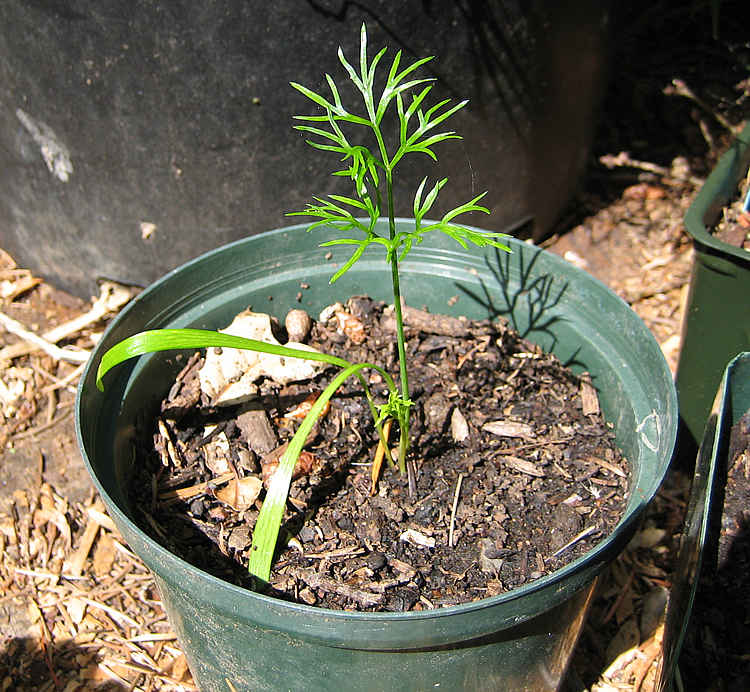
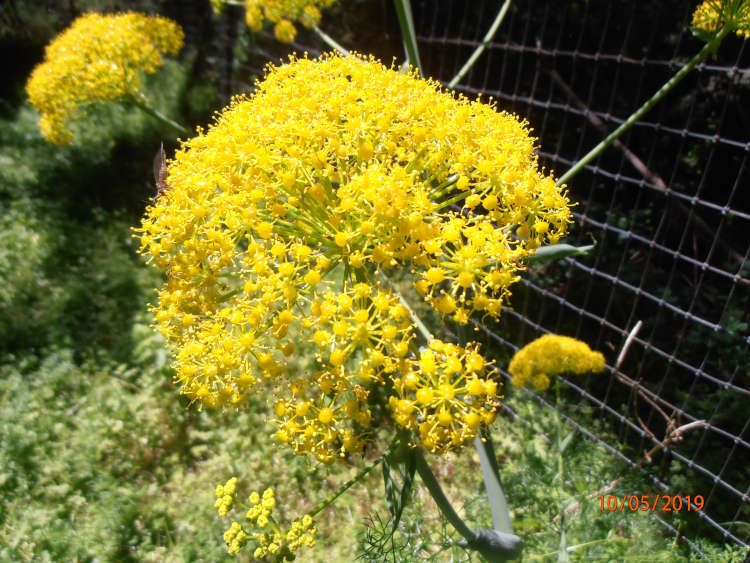
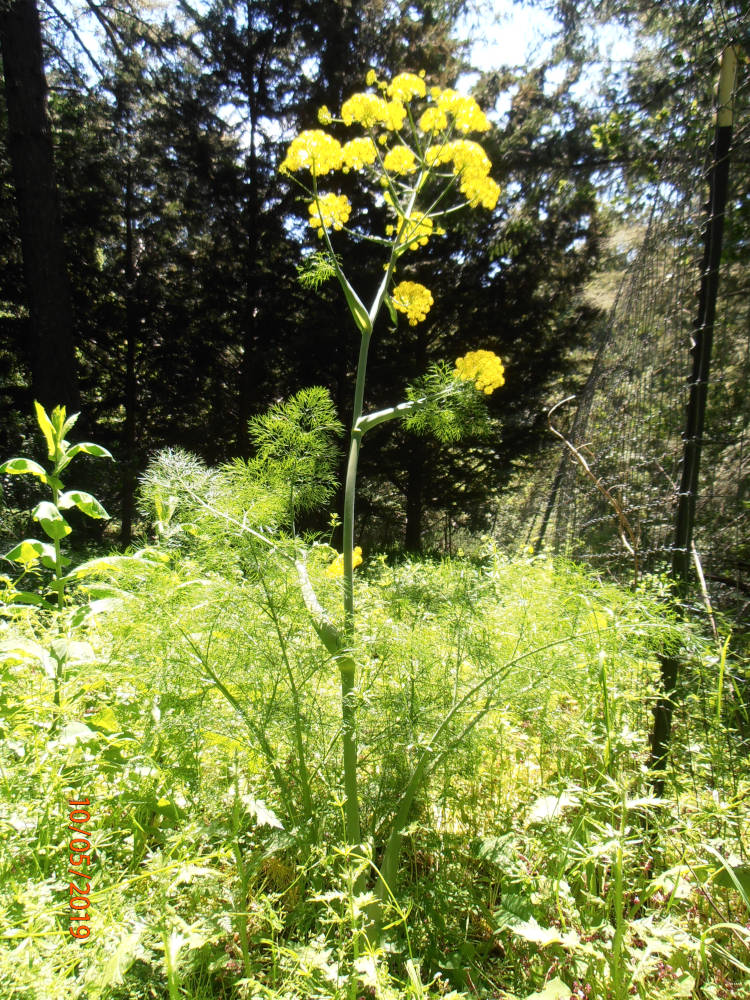
'GIANT FENNEL'. Robust perennial to 6 - 9 feet, reaching 15 feet in favored situations. Umbels of yellow flowers held above the fine mound of filmy, divided foliage. S. Europe to Syria. The stems are strong enough to have been used to make furniture, and the pith used as tinder. Produces the medicinal 'gum ammoniac', used as incense. Leaves edible. Spectacular in flower and attracts bees. Prechill seed 8 weeks to germinate in 1 - 2 weeks.
FRAGARIA (fra-GAR-ee-a)
ROSACEAE. 'STRAWBERRY'. Well-known perennials grown for their delicious fruit, attractive trifoliate leaves and charming five-petaled flowers. Easily grown in any ordinary, moist, well drained garden soil. Mulch beds with straw in winter. Many species make excellent ground covers.
—Fragaria moschata. (50) FRAG-8. Packet: $2.50
'HAUTBOIS', 'MUSK STRAWBERRY'. Violet-red berries with a strong musky flavor, likened to raspberries, held well above the foliage. Hardy perennial to 1 foot, with large white flowers in May to July. Eurasia. Zone 4. Germinates in 1 - 4 weeks.
Fragaria vesca Varieties:
'ALPINE STRAWBERRY', 'FRAISES DES BOIS', 'PERPETUAL or WOODLAND STRAWBERRY'. Bushy, compact, upright runnerless plants bear small but very flavorful and fragrant strawberries. As we who gather wild strawberries know, the modern types have sacrificed flavor for size. These small-fruited alpine types have excellent flavor, and if started early can bear some fruit the first season. Excellent for edgings and pots, and may be mowed as ground cover. Part shade or full sun. Nearly everbearing, giving all summer.
Zone 4. Sow early, barely cover, to sprout in 1 - 4 weeks at cool to warm temperatures. Plant out 6 - 12" apart.
—Fragaria vesca 'Alexandria'. (100) FRAG-2A. Packet: $2.50
Gram: $10.00
Sweet and very aromatic red fruits on bushy, runnerless plants. An excellent selection. Germinates in 1 - 4 weeks.
—Fragaria vesca 'Golden Alexandria'. (100) FRAG-2GA. Packet: $2.50
1/4 gram: $10.00
'GOLDEN-LEAVED ALPINE STRAWBERRY'. Foliage starts out golden in spring, changing to light green. White flowers and sweet, aromatic red fruits. Hardy perennial to 8". Zone 4. Nice!
—Fragaria vesca 'Alpine Yellow'. (100) FRAG-2Y. Packet: $2.50
Small yellow sweet strawberries, fragrant and flavorful. May and June. Zone 5. Germinates in 2 - 6 weeks.
—Fragaria vesca 'Ruegen'. (100) FRAG-2G. Packet: $2.50
Gram: $7.50
'ALPINE STRAWBERRY'. Large red aromatic fruits. Very productive and long bearing.
—Fragaria vesca Wildform. (100) FRAG-2W. Packet: $2.50
Gram: $10.00
'WILD WOODLAND STRAWBERRY'. Tiny red strawberries and white flowers. Forms neat 8 - 10" mounds, but has few runners. Europe. Fragrant, flavorful strawberries. Zone 4. Germinates in 2 - 8 weeks.
—Fragaria virginiana. (75) FRAG-16. Packet: $2.50
'VIRGINIA STRAWBERRY'. Aromatic red berries and white flowers in April to June. Hardy perennial to 6 - 10". E. North America. Zone 3. Leaves used as tea. Germinates in 1 - 3 weeks.
FRANCOA (fran-KO-a)
SAXIFRAGACEAE. A single variable species from Chile, often subdivided. Germinates readily.
—Francoa appendiculata. (400) FRAN-2. Packet: $2.50
Click for photo »

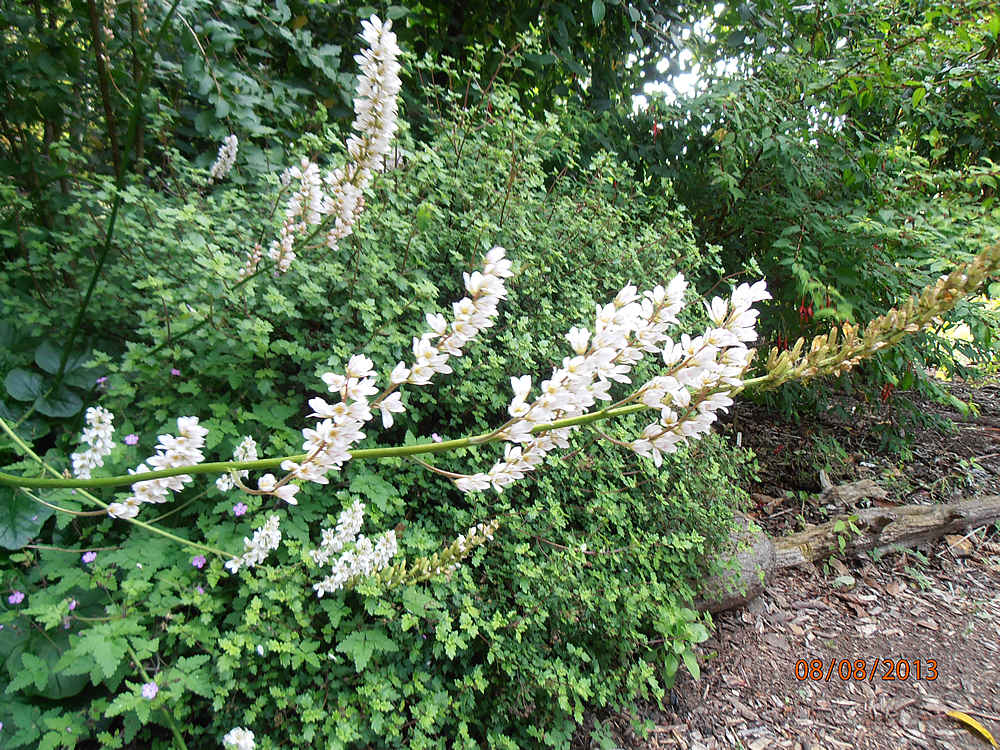

'LLAUPANGUE'. White to pink flowers marked purple inside, in spikes to 2 - 3 feet, held above a compact mound of scalloped leaves. Chile. Best in part shade and moist soil. Zone 4 to 7. Germinates in 3 weeks or so, needs light, surface sow. For more seeds and plants grown by plant-explorer Ben Kamm, including many Andean rarities, see his website at www.sacredsucculents.com
—Francoa sonchifolia. (100) FRAN-8. Packet: $2.50
1/4 gram: $18.00 BULK OUT OF STOCK - packets are available
'BRIDAL WREATH'. Small pink and white 4-petaled flowers in long sprays, July to September. Hardy perennial to 2 feet, with rosettes of lobed leaves. Chile. Zone 4. Germinates in 2 - 4 weeks or may be irregular.
FRITILLARIA (fri-ti-LAR-ee-a)
LILIACEAE. Hardy North Hemisphere bulbs with odd, often checkered, nodding bell-shaped flowers. Most do well in any rich garden soil and part shade.
—Fritillaria Meleagris Alba. (25) FRIT-26A. Packet: $2.50
Click for photo »
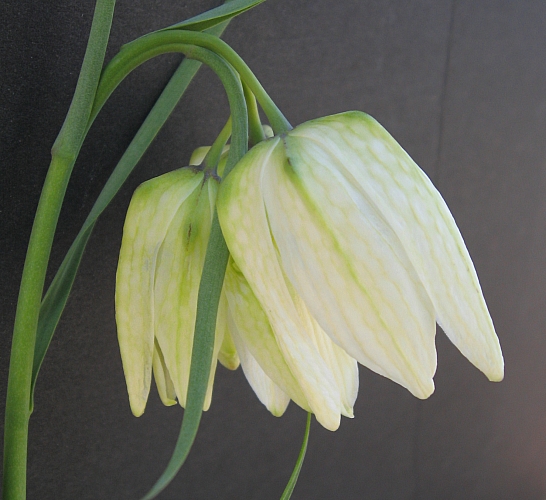
Showy white bells in late spring. Hardy bulb to 1 1/2 feet. Nice!
—Fritillaria Meleagris Pink. (50) FRIT-26P. Packet: $2.50
Gram: $7.50
FUCHSIA (FOO-sha)
ONAGRACEAE. Ornamental shrubs for mild climates.
—Fuchsia magellanica. (100) FUCH-52. Packet: $3.00
Click for photo »
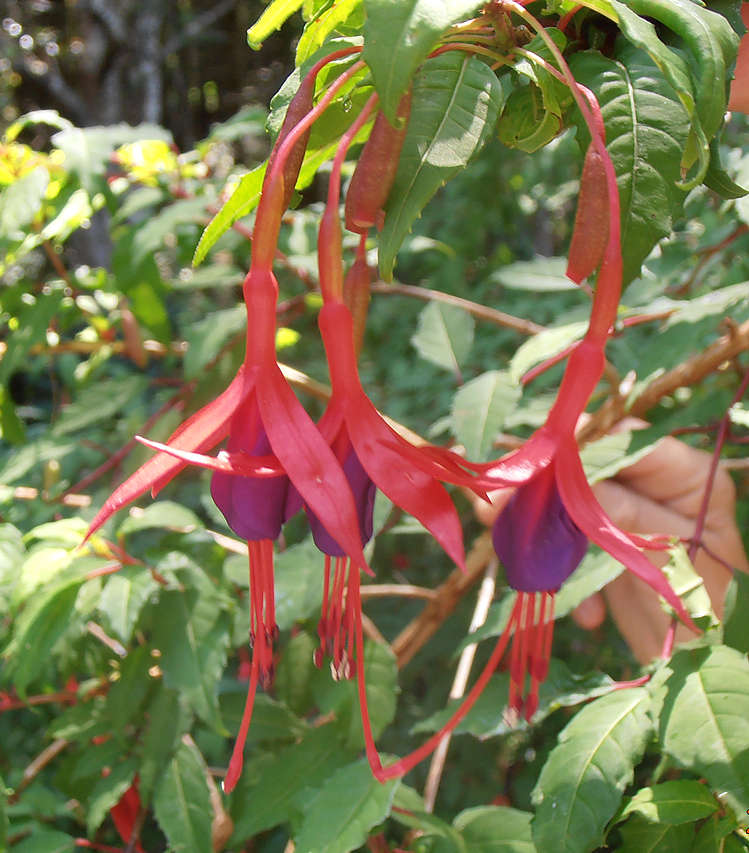
'CHILCO'. Pendulous pink and blue inch-long flowers followed by edible fruits. Shrub to 5 - 8 feet. Central and southern Chile. Zone 7. Medicinal. Moist soil. Surface sow, germinates in 2 - 4 weeks. For more seeds and plants grown by plant-explorer Ben Kamm, including many Andean rarities, see his website at www.sacredsucculents.com
GAILLARDIA (gay-LAR-dee-a)
COMPOSITAE. Showy summer-flowering annuals and perennials from the Americas. Easily grown in well-drained soil and full sun. Long period of bloom, and they last well in water and are favorite cut-flowers.
Gaillardia aristata Varieties:
'BLANKET FLOWER'. Large showy daisies up to 5" across, in rich shades of red, orange and yellow, often bordered with darker maroon zones. Blooms from June to frost, and makes excellent long lasting cut flowers. Hardy perennial to 1 - 3 feet, with deeply cut leaves. Great Plains. Zone 3. One of our finest natives, it is easily grown as an annual or perennial. Good in heat, full sun and dry areas. Germinates in 1 - 3 weeks at cool to warm temperatures.
—Gaillardia aristata 'Amber Wheels'. (20) GAIL-1A. Packet: $2.50
Large golden, fringed flowers with amber-red centers. Hardy perennial to 30". Zone 3. Cut-flower.
—Gaillardia aristata 'Bremen'. (100) GAIL-1BR. Packet: $2.50
10 grams: $7.50, 25 grams: $15.00
Nice coppery-scarlet with yellow edge. To 30".
—Gaillardia aristata 'Burgundy'. (25) GAIL-1N. Packet: $2.50
Glowing rich wine red. Showy. To 30" tall.
—Gaillardia aristata 'Goblin'. (50) GAIL-1G. Packet: $2.50
10 grams: $7.50, 50 grams: $25.00
Deep crimson 3" flowers with a yellow edge. The first dwarf, only 12 - 14" tall.
GALIUM (GAL-ee-um)
RUBIACEAE. 'BEDSTRAW'. Slender herbs with wheel-like flowers, whorled leaves and square stems. Some produce good cut flowers, others are important dye and medicinal herbs.
—Galium aparine. (100) GALI-2. Packet: $2.50
5 grams: $7.50, 25 grams: $20.00
'CLEAVERS', 'ROBIN-RUN-IN-THE-GRASS'. Scrambling annual to 2 - 6 feet, with whorled leaves and tiny white flowers. North temperate regions. The tops were made into tea, the seeds roasted for a coffee substitute, and the roots used as a substitute for madder to produce a red dye. Used as a vegetable rennet. Germinates in 3 - 4 weeks.
—Galium odoratum (=Asperula odorata) (50) GALI-18. Packet: $3.00 OUT OF STOCK
'SWEET WOODRUFF'. Sprawling perennial to 6 - 8", with whorled leaves and white flowers in clusters in May. Eurasia. Zone 3. Useful ground cover for shady places under trees, as it spreads rapidly and smothers itself with bloom. The herbage is not scented when fresh, but on drying it becomes perfumed with a delightful scent which is retained for years. The fresh shoots are steeped in wine and beer, including the famous 'May Wine' drunk on May first in Germany. They are also added to tobacco and snuff, and are placed among clothing. Germinates best sown in fall, or prechill. May be prolonged, 7 months or more, and hold pots over 2 - 3 years for stragglers.
GARDENIA (gar-DEEN-ya)
RUBIACEAE. Shrubs and trees grown in warm regions for their fragrant flowers. Sun or part shade.
—Gardenia jasminoides. (50) GARD-4. Packet: $2.50 OUT OF STOCK
5 grams: $7.50 BULK OUT OF STOCK
'CAPE JASMINE'. Highly fragrant 3" white flowers, often double. Evergreen shrub to 6 feet, with glossy dark green foliage. S. China, Japan. Zone 9. Likes summer heat.
GAURA (GAU-ra)
ONAGRACEAE. Showy-flowered North American annuals and perennials. Good in the border or the wild garden, in well-drained to sandy soil. Full sun or part shade. Grow as annuals in the North.
—Gaura Lindheimeri 'Summer Breeze'. (=Oenothera Lindheimeri). (25) GAUR-21S. Packet: $2.50
Tall, wand-like spikes of 3/4" white flowers with rosy filaments, blooming over a long period, July to October. Bushy perennial to 3 - 5 feet. Texas. This selection blooms the first year from seed, and has improved winter hardiness. Zone 5. Germinates in 2 - 6 weeks.
"We know that ants and certain Lamellicorn beetles are capable of feeling an attachment for each other, and that ants recognise their fellows after an interval of several months."—Charles Darwin.
GENISTA (je-NIS-ta)
LEGUMINOSAE. 'WOAD - WAXEN', 'BROOM'. Showy shrubs giving a profusion of yellow or white bloom in spring and summer. A number of species are hardy in the North in sheltered positions, but are at their best in full sun and dry, well-drained soil in a mild climate. Many are good ground covers for dry slopes. Easy from seed and fast growing. Rub seed on sandpaper for quick germination. Sow in pots as they resent transplanting. Seed grown plants are best as they are longer-lived.
—Genista tinctoria. (100) GENS-38. Packet: $3.00
5 grams: $15.00
'DYER'S GREENWOOD'. Bright yellow 1/2" flowers in long racemes, covering the shrub in June and July. Bright green shrub to 2 - 3 feet. Europe to W. Asia. Zone 3. A good soil binder and ground cover on dry slopes, becoming a sheet of yellow in summer. The flowers burst open when visited by insects as an aid to pollination. The flowering tops give a good yellow dye which has been used since ancient times. In combination with woad, it produces a fine green. Nick seed to germinate in 1 - 2 weeks.
GENTIANA (jen-shee-A-na)
GENTIANACEAE. 'GENTIAN'. Some 300 species of mostly perennial herbs grown in the rock garden for their beautiful flowers. As northern or alpine plants, most need cool temperatures and well-drained soil with constant moisture. Hot dry climates don't suit them, and in marginal areas plant on the north side of a stone to insure a cool root. Long-lived once established. Give loose, sandy, peaty soil, and the Asian species will not stand lime. Shade seed pans. Sow in fall or early winter, or give 2 months cold. Many are highly irregular in germination, giving seedlings in as little as two weeks, with stragglers sprouting over the next 4 years, so hold your flats! Seed half-life 3 years. Some have internal clocks.
Many gentians do best with GA-3 and cool or cold temperatures, but will give some germination at cool temperatures - usually giving plenty of plants per packet this way. Try GA-3, or 2 weeks at 40°F, then 2 weeks at 50°F.
—Gentiana asclepiadea. (200) GENT-9. Packet: $2.50
'WILLOW GENTIAN'. Deep blue 1 1/2" tubular bell-shaped flowers in clusters, July to September. Hardy perennial to 2 feet, with arching leafy stems. Europe. Zone 3. Germinates in 2 - 8 weeks warm.
—Gentiana dahurica. (200) GENT-27. Packet: $2.50
Deep blue 1 1/4" flowers in July and August. Hardy perennial to 12 - 18". NE Asia. Best in full sun, lime-free soil. Stands dryness. Best started in a potting mix with some charcoal added. Germinates in 2 - 9 weeks.
—Gentiana lutea. (100) GENT-53. Packet: $2.50
Gram: $7.50
'GREAT YELLOW GENTIAN'. Yellow inch-long wheel-like flowers in dense clusters. Robust hardy perennial to 3 - 6 feet, with thick roots. Europe. Best in the back border, in a deep moist loam. Grown for the bitter roots used in brewing and as a digestive tonic.
—Gentiana punctata. (50) GENT-94. Packet: $2.50
'SPOTTED GENTIAN'. Large 1 1/2" light yellow flowers spotted purple, in summer. Hardy perennial to 20". Central Europe.
—Gentiana purpurea. (50) GENT-96. Packet: $2.50
'PURPLE GENTIAN'. Large rich purple-red 1 1/2" club-shaped flowers striped and spotted yellow and green in the base, in clusters up the stem. Hardy perennial to 2 feet. Alps. Distinctive and unusual, showing no trace of blue. Best in peaty soil. Use GA-3 to germinate in 3 - 5 weeks warm.
—Gentiana tibetica. (100) GENT-116. Packet: $2.50
Yellow-white 1 1/4" tubular flowers clustered at the to of the stem, in late summer. Hardy perennial to 2 feet, with a rosette of foot-long leaves. Tibet. Germinates in 2 - 3 weeks warm.
GERANIUM (je-RAY-nee-um)
GERANIACEAE. Wide-ranging herbs with attractive often palmately divided leaves and charming, often showy 5-petaled flowers. Easy in most soils, good in the border, rockery and under trees. These are not greenhouse 'geraniums', which are Pelargonium.
—Geranium macrorrhizum. (10) GERN-156. Packet: $2.50
'ROCK CRANESBILL'. Deep red inch-wide flowers with exserted stamens, in clusters all summer. Hardy perennial to 18", with aromatic, deeply divided foliage. S. Europe. Nice bronze color in fall. Yields an aromatic oil called 'Zdravetz Oil'.
—Geranium maderense. (25) GERN-160. Packet: $4.00
Click for photo »
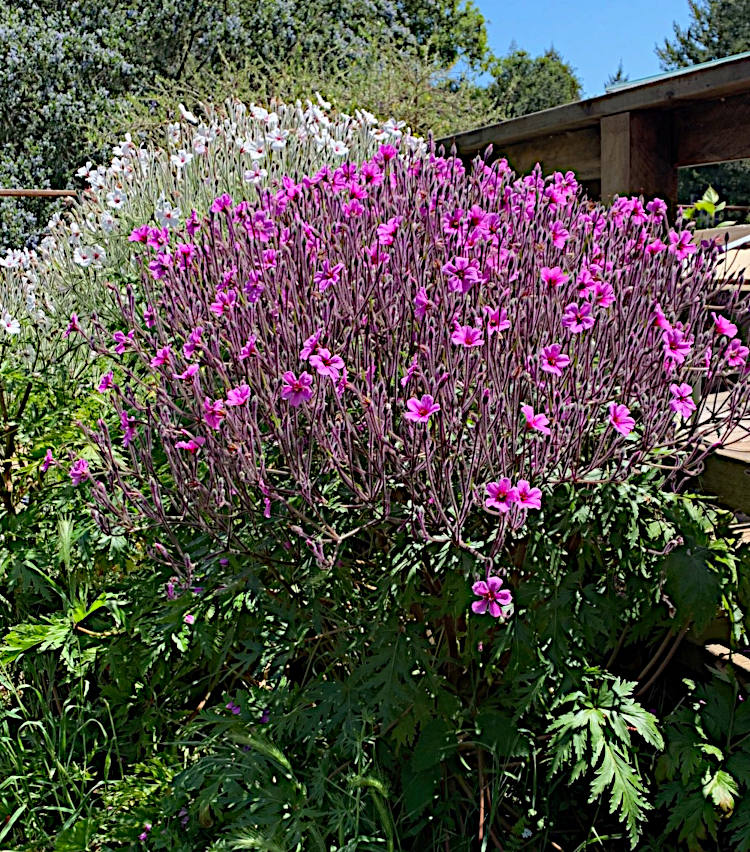
Giant species to 5 feet tall, with abundant magenta 1 1/2" wide flowers. Stout-stemmed perennial with huge 1 - 2 foot wide deeply lobed aromatic leaves with purple-tinged stems. Madeira Islands. Zone 8. Magnificent! Germinates in 2 - 4 weeks.
—Geranium maderense White. (25) GERN-160W. Packet: $4.00
Gram: $15.00, 5 grams: $50.00
Click for photo »
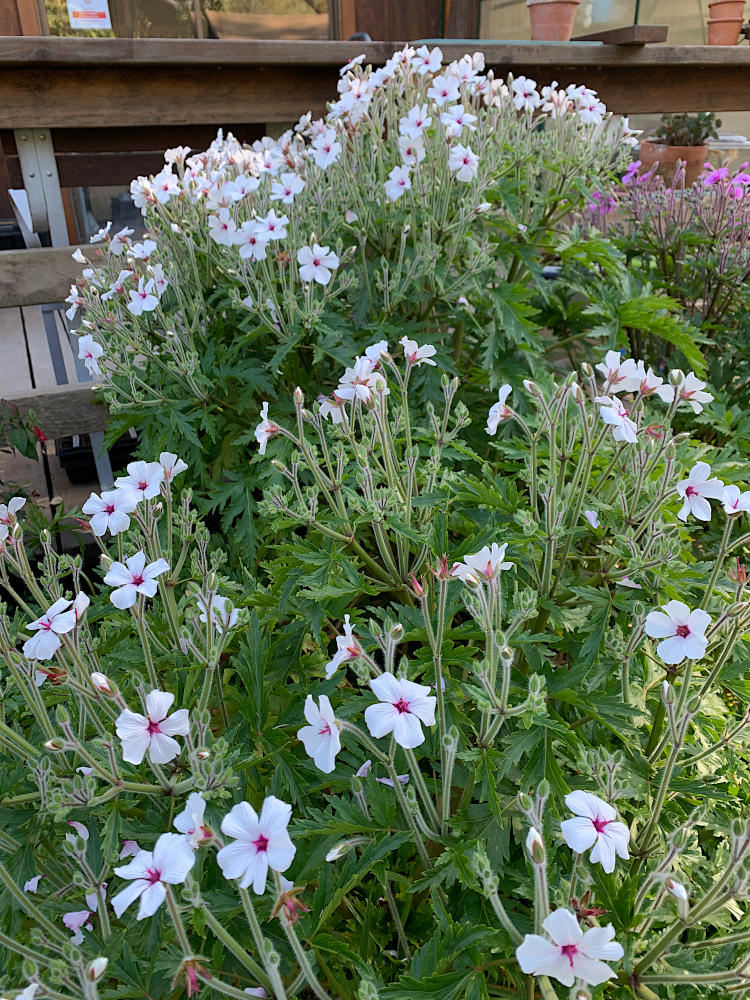
Huge clusters of white 1 3/4" flowers with pink eyes in summer. These two were grown near each other, so some crossing may be expected.
—Geranium oreganum. (10) GERN-180. Packet: $2.50
Gram: $7.50, 5 grams: $22.00
Click for photo »
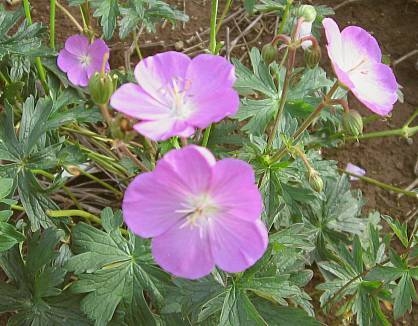
Purple 1 - 2" wide five-petaled flowers on a perennial to 1 - 2 feet with palmately divided 3 - 6" leaves. Oregon. A nice species.
—Geranium phaeum. (10) GERN-168. Packet: $2.50
'BLACK WIDOW'. Deep dark purple-black inch- wide nodding flowers in summer. Hardy perennial to 2 feet or so, with large 8" divided basal leaves. Europe. Zone 5. Good in shade.
—Geranium pratense 'Dark Reiter'. (10) GERN-185R. Packet: $4.00
Deep lilac-blue inch-wide flowers in June to August. Compact hardy perennial to 10", with stunning deep reddish-purple divided foliage. Eurasia. Zone 4. Comes 98% true from seed. Scratch seed lightly to germinate in 1 - 4 weeks.
—Geranium pratense 'Painter's Palette'. (10) GERN-185P. Packet: $2.50
Large flowers in white, soft pink, light and dark blue, violet, and white with blue splashes, June to August. Hardy perennial to 20". Eurasia. Zone 4. Scratch seed lightly to germinate in 1 - 4 weeks.
—Geranium pratense 'Striatum'. (10) GERN-185S. Packet: $4.00
'SPLISH-SPLASH'. Large white flowers attractively streaked and splashed with blue, 1 - 2" wide. Hardy perennial to 20", with shiny green 3 - 8" wide, deeply divided leaves. Eurasia. Zone 4. Scratch seed lightly to germinate in 1 - 4 weeks.
—Geranium Robertianum. (75) GERN-204. Packet: $2.50
'HERB ROBERT', 'RED ROBIN'. Dark pink to red 3/4" flowers from May to October. Annual or biennial to 4 - 20", with finely divided ferny aromatic foliage. N. Hemisphere. Good to carpet part shade. Zone 6. Medicinal. Scratch seed lightly to germinate in 1 - 4 weeks.
—Geranium yoshinoi. (10) GERN-264. Packet: $2.50
Soft pink flowers May to July, on a low hardy perennial to 16" or so, with slowly creeping stolons. Japan. Zone 5.
GLADIOLUS (gla-dee-O-lus)
IRIDACEAE. Well-known African and European tender and half-hardy cormous plants grown for their showy spikes of funnel-shaped flowers. Some are hardy in the North if mulched. Blooms best if crowded. Most germinate at cold temperatures.
—Gladiolus communis. (25) GLAD-13. Packet: $2.50
Picture: http://www.biodiversidadvirtual.org/herbarium/Gladiolus-communis.-img141792.html
Rosy red 2" flowers in 2 - 3 branches of 8 - 20 blooms, June and July. Hardy bulb to 3 feet, with sword-shaped leaves. Meadows of Europe. Zone 5. Germinates in 8 - 12 weeks at cool to cold temperatures, and KNO3 helps.
GLAUCIUM (GLOW-see-um)
PAPAVERACEAE. Distinctive annuals biennials and perennials, best in poor dry soils in full sun, where they bloom better and are longer lived. The perennials may be grown as annuals if started early, but they don't transplant well. Germinates in 1 - 3 weeks at cool to warm temperatures. Sow in spring or fall. "Striking plants for the border or wild garden."—C.O. Booth.
—Glaucium flavum var. aurantiacum. (50) GLAU-2A. Packet: $2.50
'ORANGE HORNED POPPY'. Large showy orange-red 2 - 3" flowers followed by foot-long ornamental pods. Hardy biennial or perennial to 20", with striking rosettes of glaucous succulent lobed blue-green foliage. Europe. Zone 5. Good in poor sandy soil. Use GA-3 to germinate in 2 - 4 weeks.
GLEDITSIA (gle-DIT-shee-a)
LEGUMINOSAE. 'HONEY LOCUST'. Handsome ornamental trees grown throughout the world. Vigorous, hardy, fast growing, drought resistant, standing almost any soil except heavy clay. They are excellent for shade, impenetrable hedges, timber and fuelwood production, erosion control, human, livestock and wildlife food, shelterbelts, etc. Tolerates alkalinity and salinity. Easy from seed, but has a hard seed coat. Either nick and soak, or cover with 3 - 4 times their volume with almost boiling water and soak till swollen. Sow shallowly to germinate in 1 - 4 weeks warm.
—Gleditsia sinensis. (10) GLED-8. Packet: $3.50
Ounce: $9.00
'CHINESE HONEYLOCUST'. Attractive rare small tree to 40 feet, with pinnate 8" leaves and small clusters of flowers followed by flat 10" pods. China and Mongolia. Zone 5. Nick seed to germinate in 2 weeks.
—Gleditsia triacanthos inermis. (25) GLED-10N. Packet: $2.00
1/4 Pound: $11.00
'THORNLESS HONEYLOCUST'. Thornlessness is a genetically dominant trait and comes true from seed. Other than lack of thorns, this tree has all of the fine properties of the thorny kind. "Over half of my thornless honey locusts wintered over! Many days we dropped below –40°F."—D.J., Saskatchewan. 1/97.
GLEHNIA (GLE-nee-a)
UMBELLIFERAE. One or two species.
—Glehnia littoralis. (30) GLEH-6. Packet: $2.50
'BEACH - CARROT', 'HAMA - BOFU'. White flowers in several ball-shaped clusters together on whitish stems. Attractive reddish seed-balls. Stemless hardy perennial growing in coastal dunes of the north Pacific. In Japan the young leaves and stems are pickled and eaten, said to taste like angelica and tarragon. Sow in fall or prechill 8 - 12 weeks.
GLOBULARIA (glob-u-LAR-ee-a)
GLOBULARIACEAE. Ornamental herbs and subshrubs from the Mediterranean region, with blue flowers in ball-like heads. Easy from seed and good in full sun and well-drained soil. Germination irregular, from 9 to 106 days.
—Globularia nudicaulis. (50) GLOB-17. Packet: $2.50
Blue puff-like 1" flowers held above a low mound of shining leaves. Hardy perennial to 6" or so. Spain to Yugoslavia. Zone 3. Best in lime soil.
GLYCYRRHIZA (gli-sir-RI-za)
LEGUMINOSAE. Wide ranging perennials with pinnate leaves and spikes of flowers in summer. Good in the flower garden or grown for the sweet roots.
—Glycyrrhiza glabra. (20) GLYC-10. Packet: $3.50
'LICORICE'. Pale blue 1/2" flowers in dense spikes in July to September. Graceful perennial to 3 - 4 feet, with feathery pinnate leaves. Mediterranean to SW Asia. Much grown for the production of licorice roots, which contain glycyrrhizin, 50 times sweeter than sucrose. Leaves were used as tea by the Mongols. For best quality roots, a deep fertile soil with water during the growing season but hot, dry weather in late summer. Harvest roots the second or third season. Germinates in 1 - 6 weeks.
—Glycyrrhiza uralensis. (10) GLYC-24. Packet: $3.00
'GAN CAO', 'CHINESE LICORICE'. Hardy perennial to 3 feet, with white-violet flowers in spikes and feathery foliage. China. The source of Chinese licorice, used as a Qi tonic and adaptogen. Germinates in 2 - 4 weeks.
—Glycyrrhiza yunnanensis. (20) GLYC-28. Packet: $2.50
Nice photo of pods: http://www.gapphotos.com/imagedetails.asp?imageno=298893
Info: http://www.efloras.org/florataxon.aspx?flora_id=2&taxon_id=242323675
'YUNNAN LICORICE', 'YUN NAN GAN CAO'. Small purple flowers in dense heads in May and June, followed by pods with pinkish hairs. Perennial to 3 feet, with feathery 4" leaves. Mts. of Yunnan, China, to 8000 feet. Zone 8 or 9. Nick seed to germinate in 1 - 2 weeks.
GOMPHRENA (gom-FREE-na)
AMARANTHACEAE. 'GLOBE AMARANTH'. Popular annuals and perennials grown for their brilliantly colored clover-like flowerheads, which are among the best everlastings. Good for borders and edging. Prefers rich, well-drained soil in full sun, and they tolerate drought and hot weather. Good pot plants for a sunny window. Best started indoors in February and March, or outdoors after danger of frost. Germinates in 1 - 3 weeks at warm temperatures. Space 12" apart or grow in 5" pots. Cut flowers when almost fully open for drying in an airy place.
—Gomphrena haageana 'Strawberry Fields'. (50) GOMP-12S. Packet: $2.50
10 grams: $9.00, 25 grams: $18.00
True scarlet-red 2" flower-heads in great profusion. Good for cutting, they keep their color dried. Annual to 1 - 2 feet. Germinates in 1 - 3 weeks.
GRINDELIA (grin-DEL-ee-a)
COMPOSITAE. Free-blooming herbs of western North America and South America. Good for hot, dry sunny places, and are favorite western wildflowers. Easy.
—Grindelia camporum var. camporum. (100) GRIN-8. Packet: $2.50
10 grams: $7.50
'GREAT VALLEY GUM-PLANT'. Bright yellow 1 1/2" flowers in summer, on a perennial to 4 feet or more, with narrow leaves. California. Zone 7. Stands drought and salt, and is a prime pollinator attractor. The resinous flowers and tips are used for dermatitis, lung problems, and as a sedative. Germinates in 1 - 6 weeks, best with a one week prechill.
GUNNERA (GUN-er-a or gu-NER-a)
GUNNERACEAE. Perennial herbs ranging from gigantic plants grown for their bold foliage, down to tiny mat-forming dwarfs. Best in cool, moist, mild climates—excellent on the Pacific coast.
I've had the best results by rubbing the seed out of its husk, then soaking in rubbing alcohol for 15 minutes to remove germination inhibitors. Then it will give good germination over 1 - 10 months.
—Gunnera manicata. (100) GUNN-16. Packet: $3.00 OUT OF STOCK
'GIANT GUNNERA'. Gigantic leaves can reach 5 - 10 feet across, rising in a cluster from the crown. Flower cluster 1 foot thick and 3 - 4 feet tall. S. Brazil. Zone 7. Occasionally forms a magnificent clump 25 - 35 feet across. Best grown near a pond to insure a steady supply of moisture.
GYMNOCLADUS (JIM-no-KLAD-us)
LEGUMINOSAE. Two species of deciduous trees grown for ornament and timber. Stands heat, cold, drought and poor soil. Seed has a very hard coat and needs deep nicking to germinate in 2 - 6 weeks.
—Gymnocladus chinensis. (5) GYMC-6. Packet: $5.00
'FEI-TSAO-CHIA'. Large tree with white flowers and with smaller and more numerous leaflets than the American species, and with much thicker 3 - 4 pods. Central China. Almost unknown in the US. The pounded unripe pods were used as washing soap and are used medicinally for rheumatism, dysentery, and hematuria. Seeds eaten roasted. Nick and soak to germinate in 2 - 4 weeks.
—Gymnocladus dioica. (10) GYMC-1. Packet: $2.50 OUT OF STOCK
1/4 Pound: $10.00, Pound: $30.00 BULK OUT OF STOCK
'KENTUCKY COFFEE TREE'. Large tree to 50 - 110 feet, with large 1 1/2 - 3 foot long bipinnate leaves, which are pinkish in spring, deep green in summer, and clear yellow in fall. Greenish 1/2" flowers in foot-long racemes on female trees, 4" clusters on males. Females produce persistent thick red-brown 6 - 10" pods filled with large seed and pulp. E. U.S. Zone 4. The seeds are said to have been roasted as a coffee substitute in the 1700's, and were roasted and eaten like nuts by the Indians. The bruised leaves or pod pulp sprinkled with sweetened water are said to attract and kill flies. "One of the most handsome of all hardy trees."—Hilliers. The seeds were used as counters in an Indian game. They make excellent beads, taking on a high polish.