MALVACEAE. Widely distributed warm-region herbs and shrubs, grown for ornament, fiber and medicine.
—Sida spinosa. (50) SIDA-76. Packet: $2.50
5 grams: $7.50
'INDIAN MALLOW', 'TEA WEED'. Pale yellow 1/3" flowers on an annual to 2 - 3 feet. SE U.S. and the tropics. Has antibacterial, antifungal, anti-inflammatory, anti-diabetic, and many other medicinal properties, long used in Ayurveda. Germinates in 1 - 2 weeks.
SIDERITIS (see-der-EE-tis)
LABIATAE. Ornamental herbs and shrubs.
—Sideritis syriaca. (25) SIDE-76. Packet: $2.50
'GREEK MOUNTAIN TEA'. Yellow 1/2" flowers in spikes. Perennial to 10 - 20", with 2" white-woolly leaves. Crete. Zone 6. Brewed into a golden-colored aromatic tea. Germinates in 1 - 2 weeks.
SILENE (see-LAY-nay)
CARYOPHYLLACEAE. Five hundred species of North Hemisphere annuals, biennials and perennials with showy flowers produced in profusion. Easily grown and valued in the border or rockery. Best in full sun and sandy soil, and even the annuals can be sown in fall for earlier bloom. Most kinds germinate in 8 - 23 days and flower quickly. They have extrafloral nectaries.
—Silene capensis. (75) SILE-6. Packet: $2.50
1/4 gram: $15.00, Gram: $25.00
Click for photo of seedlings »
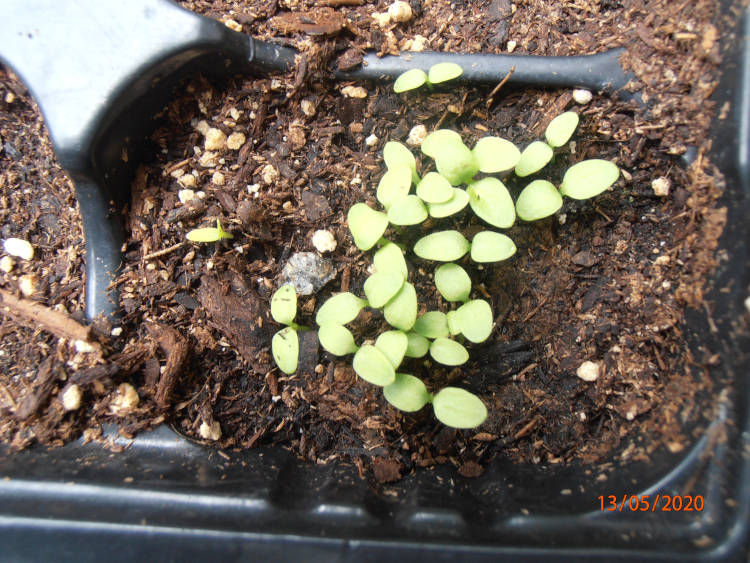
'XHOSA DREAM PLANT', KWAQUELA', 'MOLOKOLOKO'. 'White to pink five-petaled flowers. Perennial to 1 - 2 feet, with 1 - 3" leaves. South Africa. Moist sandy soil. The root is said to be used by the Xhosa to induce vivid dreams. Germinates in 3 - 8 weeks, best with 2000ppm KNO3 (potassium nitrate), or GA-3.
SILYBUM (SI-lee-bum or si-LEE-bum)
COMPOSITAE. 'MILK THISTLE'. Striking plants. Sow in fall or spring where they are to grow and thin to 2 feet apart. Sprouts in 1 - 3 weeks. An interesting note: fresh seed will not germinate at warm temperatures, only sprouting at cool temperatures; but after 5 months dry storage (after-ripening) they will germinate well at warm temperatures.
—Silybum Marianum. (200) SILY-3. Packet: $2.50 ORGANIC
Ounce: $5.00, 1/4 pound: $10.00
'ST. MARY'S MILK THISTLE'. Bold and striking rosettes of large glossy, dark green, spiny leaves streaked and marbled with white, followed by 2" wide rose-purple, faintly scented flower-heads on 4 - 6 foot stalks, each head with dramatic reflexed spines. Mediterranean region. Zone 4. Old tradition holds that milk of the Virgin Mary fell upon the plant, causing the white marbling of the leaves. Flowers much visited by bees; later, birds love the seeds. California ranchers claim it loosens hard, compacted soil, and make their own 'clod-buster' from chopped plants soaked in 55 gallon drums of water. Formerly much used as food; the young leaves in salads or boiled, (I've never tried this myself, the spines scare me!) the peeled stalks, the roots like salsify, the young heads eaten like artichokes after cutting off the spines. Was thought to increase milk in nursing women. Since ancient times the seeds have been used as liver medicine, and recently their powerful liver-protective properties have found much use in modern medicine. Experiments have shown it capable of preventing death in dogs from fatal doses of Destroying-Angel mushroom toxins.
SIPHOCAMPYLUS (see-fo-KAM-pee-lus)
CAMPANULACEAE. Tropical American shrubs.
—Siphocampylos tupaeformis BK09428.1. (500) SIPH-86. Packet: $4.00
'COCHAYA', 'PISHQU SHOQUNAN'. Tubular tricolor yellow, orange, and red flowers in large clusters. Perennial to 3 - 5 feet, with lanceolate leaves. Near Cusco, Peru, at 11,000 feet. Attracts hummingbirds. Planted alongside San Pedro as a 'guardian'. Zone 8. Regrows after frost. Surface sow to germinate in 2 - 12 weeks. For more seeds and plants grown by plant-explorer Ben Kamm, including many Andean rarities, see his website at www.sacredsucculents.com
SISYRINCHIUM (si-si-RIN-kee-um)
IRIDACEAE. 'BLUE-EYED GRASS'. Small American grass-like perennials with blue or yellow flowers. They make nice colonies in open moist places. Easy in any soil. Good in pots.
—Sisyrinchium angustifolium. (100) SISY-3. Packet: $2.50
Click for photo »
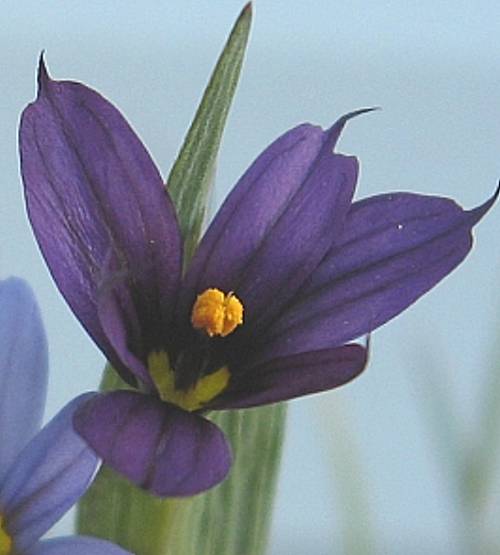
'BLUE-EYED GRASS'. Blue 1/2" flowers on winged stems. Deep green grass-like leaves. Hardy short-lived perennial, reseeding itself. Reaches 2 feet in good moist soil, but will grow in dry shade, reaching only 4 - 6". E. N. America. Used medicinally. Sow in fall.
—Sisyrinchium angustifolium Dark Blue. (100) SISY-3B. Packet: $2.50
5 grams: $10.00
'BLUE-EYED GRASS'. A very dark blue strain with 1/2" flowers. Needs light to germinate.
—Sisyrinchium inflatum. (50) SISY-12. Packet: $2.50
Bright pinkish purple nodding 3/4" flowers with lighter centers, on a dainty plant to 6 - 15" tall, with narrow, grass-like 2 - 3" leaves. Washington. Zone 5. Germinates in 4 - 8 weeks at cold temperatures.
SMILAX (SMI-lax)
LILIACEAE or SMILACACEAE. Woody or herbaceous vines from thick roots, grown for their handsome foliage. Seeds may be difficult to germinate; hold pots several years. Attractive and worth the effort.
NEW—Smilax Bona-nox. (10) SMIX-8. Packet: $2.50
'CAT BRIER'. Tall hardy perennial dioecious vine to 20 feet, with heart-shaped leaves and small flowers in clusters, followed by black fruits. S.E. U.S. Zone 6. The large tubers were made into bread by Indians, the young shoots eaten, and medicinal.
NEW—Smilax hispida. (10) SMIX-36. Packet: $2.50
'BRISTLY SARSAPARILLA'. Tall dioecious climber to 10 - 20 feet, with bristly stems, oval leaves, and clusters of small flowers followed by bluish-black berries. E. N. America. Zone 2. Young shoots eaten, and was used in Indian witchcraft.
"Besides love and sympathy, animals exhibit other qualities connected with social instincts, which in us would be called moral; and I agree with Agassiz that dogs possess something very like a conscience."—Charles Darwin.
SMYRNIUM (SMIR-nee-um)
UMBELLIFERAE. Hardy Old World biennial herbs with handsome divided foliage and yellow flowers.
—Smyrnium Olusatrum. (50) SMYR-18. Packet: $2.50
Ounce: $10.00, 1/4 Pound: $30.00, Pound: $70.00
Click for photo »
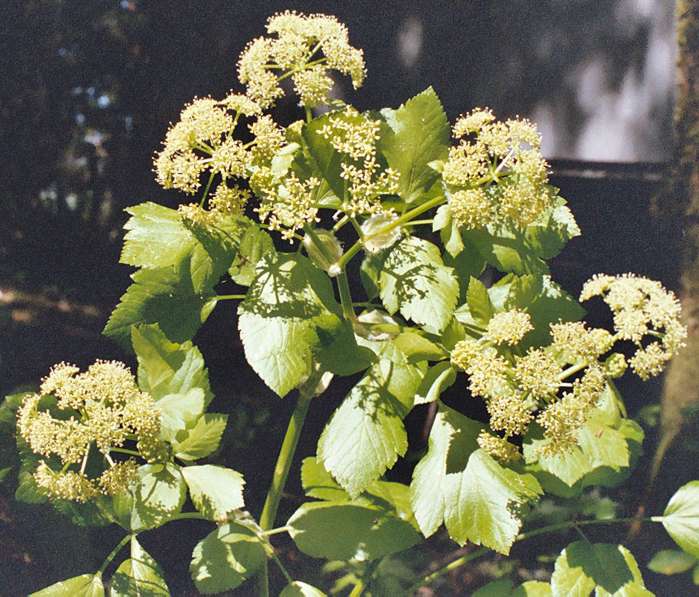
'ALEXANDERS', 'BLACK LOVAGE'. Stout biennial or perennial to 4 feet, with large glossy bright green divided leaves. Yellow flowers in 4" umbels, followed by black 1/4" fruits. Mediterranean. An ancient vegetable, it is mentioned by Theophrastus (322 BCE), was cultivated by Charlemagne (800 CE), reached the height of its popularity around 1550 to 1650, and had almost disappeared by the late 1800s, being displaced by celery. The young shoots and stalks were blanched and eaten, and have a celery-like flavor, but more pungent, and were used to flavor soups and stews. The sliced root was eaten raw in salads. Unopened flower clusters eaten. Germinates best in summer, seed sown in August germinates in 2 weeks. Fresh seed needs cold treatment. Hardy to Zone 5. Seedlings thinned out can be eaten. A forgotten plant. Germination is greatly increased by rubbing the black husks off the seed to germinate in 3 - 6 weeks without cold treatment.
SOLANUM (so-LA-num)
SOLANACEAE. A huge genus of 1400 species, from annuals to trees. Includes important foods (potato, eggplant, etc.), medicines, industrial crops and many ornamentals. Generally easy from seed, germinates in 1 - 3 weeks. Sow hardy types where they are to stand, and tender types early indoors. They are wonderful plants, many very ornamental, but surprisingly little grown. Buy 'em or lose 'em!
Nice collection of photos of Solanum species.
—Solanum aviculare. (50) SOLN-8. Packet: $2.50
'KANGAROO APPLE', 'KOONYANG', 'MAYAKITCH' (aboriginal names). Violet 1" flowers in clusters, followed by 1" yellow berries. Handsome shrub to 5 - 10 feet, with narrow, dark green, foot-long lobed leaves. Australia and N.Z. Zone 9. Often blooms the first year, and is a nice ornamental here in California. The leaves and stems are a rich source of the glycoalkaloid solasodine, used in the synthesis of steroids. The fully ripe fruits, after they have fallen, are said to be eaten raw, boiled or baked; if at all unripe they burn the mouth. Germinates in 2 - 4 weeks warm.
—Solanum X Burbankii. (100) SOLN-9. Packet: $2.00
Click for photo of seedlings »
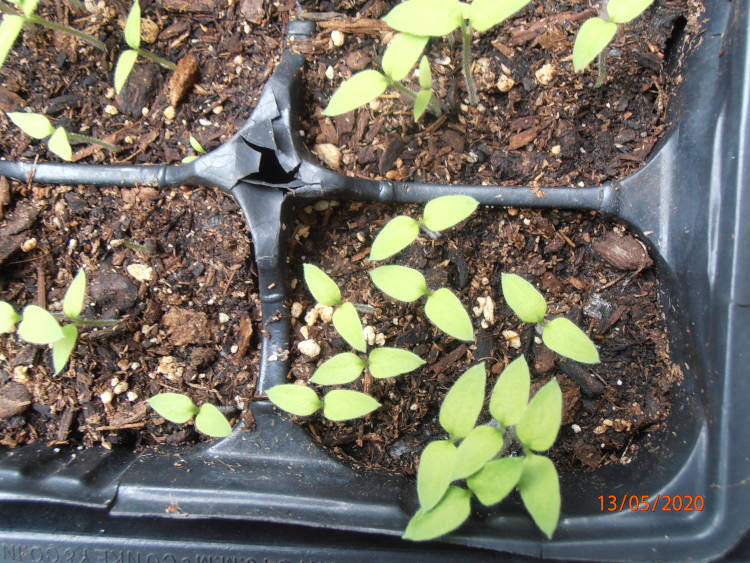
'WONDERBERRY', 'MSOBA'. Deep blue 1/4" fruits with white bloom are sweet and edible, used for tarts, jams, etc. Compact annual to 2 feet. Caused a great controversy when introduced by Luther Burbank. Delicious and productive. Sow on the surface, seed needs light or GA-3 to germinate in 2 - 3 weeks.
SOLIDAGO (so-li-DA-go)
COMPOSITAE. Summer and fall flowering perennials. Excellent in the border where their yellow flowers harmonize beautifully with the blue flowered native Asters. Too-little appreciated as garden plants where their flower-clusters become larger and fuller than in the wild. Do not over-fertilize. Easy from seed, germinates in 2 - 7 weeks at cool temperatures. They do not cause hay fever.
—Solidago canadensis. (250) SOLI-12. Packet: $2.50
'CANADA GOLDENROD'. Large branching sprays of golden-yellow flowers in late summer and autumn. Hardy rhizomatous perennial to 5 feet, with narrow 4" leaves. NE N. America. The Indians used it medicinally for many ailments, the Navajo used it as a charm for gambling luck, and smoked the roots mixed with tobacco. Germinates in 1 - 2 weeks.
SOPHORA (so-FOR-a or SOF-or-a)
LEGUMINOSAE. Wide-ranging and showy ornamental mostly woody plants with clustered pea-like flowers and handsome pinnate foliage. Best in well-drained soil, and most stand drought well.
—Sophora secundiflora. (10) SOPH-6. Packet: $3.00
'MESCAL BEAN', 'TEXAS MOUNTAIN LAUREL', 'FRIJOLITO'. Beautiful fragrant violet-blue inch-long flowers in dense 3" clusters covering the plant in spring. Handsome evergreen shrub to 4 - 6 feet, rarely a tree to 40 feet, with shining dark green pinnate foliage. Silvery grey 1 - 8" pods with bright red seeds. Texas to New Mexico. Can stand a good freeze—Zone 8. Well-drained soil. The poisonous seeds are used as beads and ceremonially by Plains Indians, and are powdered for insecticide. Nick seed to germinate in 1 - 4 weeks or so.
SPHAERALCEA (sfeer-AL-see-a)
MALVACEAE. Ornamental shrubs and herbs of arid regions of the Americas. Grown for their often showy flowers. Good outdoors in warm regions. Some are fairly hardy and others good in the greenhouse. Nicking the seed may help germination.
—Sphaeralcea ambigua. (250) SPHA-4. Packet: $2.50
5 Grams: $7.50
'DESERT GLOBEMALLOW'. Bright orange-red 1 - 2 1/2" flowers in clusters, with conspicuous yellow stamens. March to June. Perennial to 3 feet, with greyish three-lobed 1 - 2 1/2" leaves. Utah to southern California. Spectacular and drought resistant, hardy to at least Zone 4. Nick seed or give hot water treatment to germinate in 2 - 3 weeks warm.
—Sphaeralcea coccinea. (100) SPHA-8. Packet: $2.50
5 Grams: $7.50 BULK OUT OF STOCK - packets are still available
'SCARLET GLOBEMALLOW'. Scarlet 1 1/2" mallow-like flowers in short racemes. Hardy perennial to 2 feet, with greyish, divided leaves. Manitoba to Arizona. Zone 4. Nick seed or give hot water treatment to germinate in 1 - 2 weeks warm.
—Sphaeralcea Munroana. (250) SPHA-28. Packet: $2.50
5 grams: $7.50, 25 grams: $20.00
'MUNROE GLOBEMALLOW'. Bright orange 1 1/2" flowers in long sprays in summer and fall. Perennial to 1 - 2 feet, with grey-green leaves. W. N. America. Zone 4.
"So the universe would be a very great book, and we would be very small readers."—U. K. LeGuin.
STACHYS (STA-keez)
LABIATAE. Widespread perennials and annuals adapted to varied conditions, from dry to wet. Tubular, often hooded flowers in whorls, and often aromatic foliage. Some are medicinal.
—Stachys officinalis. (=Betonica) (100) STAC-14. Packet: $2.50
'WOOD BETONY'. Very rich purple 1/2" flowers in dense whorls and spikes. Hardy perennial to 3 feet, with 3 - 6" leaves. Europe, Middle East. Zone 4. Good ornamental, formerly much cultivated for medicinal use. Highly regarded for many ailments, and believed effective against 'devils and despair'. The tea is a fine beverage and was formerly valued against persistent headaches. "Sell your coat and buy Betony."—Italian proverb. Germinates in 2 - 4 weeks.
STEVIA (STE-vee-a)
COMPOSITAE. From the warm Americas.
—Stevia rebaudiana. (30) STEV-21. Packet: $4.00
'SWEET LEAF'. Small shrub with tiny white flowers and narrow leaves. Paraguay. The dried leaves are used as a no-calorie sweetener. Surprisingly hardy, standing some freezes and renewing from the base. Germinates in 1 - 2 weeks.
SYRINGA (si-RIN-ja)
OLEACEAE. Showy deciduous Eurasian flowering shrubs and small trees.
NEW—Syringa Josikaea. (50) SYRI-12. Packet: $2.50
'HUNGARIAN LILAC'. Fragrant deep blue-violet flowers in 4 - 6" clusters in summer. Hardy shrub to 12 feet, with glossy dark green 5" leaves. Mountains of eastern Europe. Zone 4 or 5. Germinates in 1 - 3 weeks.
—Syringa reticulata. (25) SYRI-22. Packet: $2.50
'JAPANESE TREE LILAC'. Creamy white musk-scented flowers in foot long clusters in summer. Small tree to 30 feet, with 5" leaves. N. Japan. Zone 4. Germinates in 4 - 12 weeks.